

You asked, so we just had to deliver!
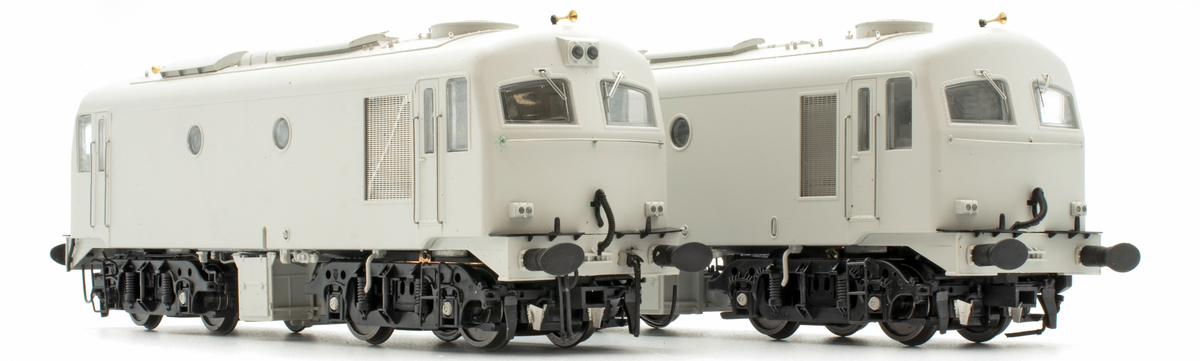
The missing link in Irish model diesel locomotives is now coming to your layout, as we unveil the Metropolitan Vickers C Class locomotives.
34 of these underpowered locomotives were built for CIE and delivered from 1957. We have published an in depth history on the locomotives here, along with individual class member histories of the 10 locomotives we are featuring in the first run below!
The Model

From the ground up, we have set out once again to make the very best locomotive we can. Our C Class can trace its lineage back to our first ever locomotive, the A Class, just like the real locomotives.
However, the C has benefitted from us now delivering years of multi-award winning locomotives from IRM and Accurascale over the past 5 years, and the A Class itself was a very strong starting point in itself!
So, you know these are going to be top level, especially if you treated yourself to an NIR Hunslet Locomotive recently...

Naturally, despite their diminutive status, each loco is ftted with a heavy die-cast metal chassis to give the C Class some reassuring heft and help it stay firmly on the rails. But it's the details around that chassis that really help bring the model to life.
We've produced two main bogie variants, with separate footsteps, sandboxes, speed recorders and plenty of pipework to capture the differences between individual locomotives. Depending on the version you're modelling, you'll also find either rotating axlebox hubs or the original Hoffman covers on the bogie sideframes.

The brake blocks sit correctly in line with the wheels, and we've used RP25-110 OO wheels for a fine running profile. For those of you who prefer your Irish outline models on the proper 21mm gauge, we've also made provision for re-gauging.
Moving up to the bodywork, we've used scale-width wire handrails alongside a mixture of etched metal and finely detailed plastic parts. Grab handles, steps, wipers and antennas are all represented, adding plenty of depth while making the model look prototypical.
The roof gets its fair share of attention, too. There's a super-fine eroded-metal grille, complete with a working fan, plus etched metal worksplates and a turned brass horn on the cab roof. Little touches, perhaps, but they're exactly the sort of details that make a difference when you get the model out of the box.

Underneath, you'll find two different styles of battery box and fuel tank, complete with their brackets and associated pipework. We've also included two styles of sprung metal buffer in the tooling, with additional pipework and dummy screw couplings in the accessory pack for those who want to add a little extra character.
And because a model needs to be practical as well as pretty, we've fitted NEM coupler mounts at the correct height, complete with mini-tension-lock couplings. In other words, they will be more reliable than the real thing!
Smooth running, with a bit of muscle
All that detail would count for very little if the locomotive didn't perform properly. Thankfully, we've put just as much effort into what goes on underneath as what you can see on top.
Power comes from a high-quality five-pole motor with twin flywheels, working alongside a helical gearbox designed to deliver smooth performance and excellent low-speed control.

We've geared the model for a scale maximum speed of 80mph (130km/h), giving it a realistic top speed. All-wheel drive and all-wheel pickup help keep things moving reliably, while the DCC-ready version also includes a PowerPack capacitor to help the locomotive maintain its momentum over less-than-perfect trackwork.
For those choosing the factory-fitted DCC sound version, there's an additional trick up our sleeve. A Hall sensor allows flange-squeal effects to be triggered, adding another layer of realism when the locomotive tackles curves. It's one of those little extras that can make a big difference to the overall experience.
Let there be light!
We've also given the lighting package plenty of attention, because there's more to locomotive lighting than simply switching the headlights on and off.

Directional lighting works on both DC and DCC, while switchable red tail lights and white marker lights give you the flexibility to set the locomotive up for different operating situations.
The rebuilt version also benefits from a switchable headlight, allowing the appropriate arrangement to be selected.
Inside the cab, we've included cab lighting and an illuminated driver's desk, while engine bay lighting adds even more atmosphere. There's also an automatic lighting function with an off-on-movement feature, helping create that convincing impression of a locomotive sitting quietly before getting ready for work.
Whether you're recreating a locomotive at rest in the depot, preparing it for its next duty or watching it head out onto the main line, these features give you plenty of options.
DCC ready, or ready to make some noise!
When it comes to choosing your model, there are two main options.

The DCC-ready version comes fitted with a 21-pin MTX decoder socket, giving you the freedom to install your preferred decoder and set things up just the way you like them.
If you'd rather get straight to the sound, the factory-fitted DCC sound version comes with two quality speakers to deliver an immersive audio experience. Combined with the flange-squeal functionality, it's designed to bring a little more life to your operating sessions.
Whichever version you choose, the aim is the same: a model that's packed with character, runs beautifully and gives you plenty to enjoy long after you've opened the box.
The Prototypes
IRM1376 C201 Silver

The first of the C Class, C201, arrived at North Wall, Dublin, on 2 February 1957, wearing the same all-over silver livery that had proved so striking on the A Class locomotives delivered over the previous two years. The Crossley-powered Metrovick made its operational debut a month later, working alongside C202 on the 34-mile Farranfore–Valentia Harbour route, notably the most westerly railway line in Europe. It was also recorded working the Castlecomer branch.
Sadly, C201 worked the last Up train on the Valentia Harbour branch in January 1960, after which it transferred to the Midland section. It was rebuilt with a GM B-645E engine in June 1971 but was subsequently stored after being damaged in a bombing at Meigh in August 1973.
IRM1377 C231 Green with Eau-de-Nil Stripe (ITG Fundraising Limited Edition)

Now preserved at the Downpatrick & County Down Railway in Northern Ireland, C231 was the first member of the class to receive CIÉ’s new lined green livery, introduced in January 1958 to replace silver.
Like many of its classmates, C231 helped close the branch lines it had originally been acquired to serve, in this case the Roscrea–Birr line in January 1963. Its GM repowering was completed in February 1972. After 11 years of further service, it was stopped in July 1983 and withdrawn two months later.
The locomotive was acquired by the Irish Traction Group in November 1992 as a source of spare parts for the society’s other C Class locomotive, 226. However, its condition proved sufficiently promising for it to become a candidate for reactivation itself. In 1996, it was repainted in its original 1950s green livery for display at the Inchicore 150 event that June.
Three years later, C231 moved to RMS Locotec at Dewsbury, West Yorkshire, for electrical and cooler-group work. This eventually saw its 645 engine successfully started for the first time in 17 years. In August 2000, it appeared at the Old Oak Common open day before returning to Inchicore, where it remained in storage until 2009.
Its next move was to the West Clare Railway at Moyasta, but in June 2014 it was transferred to Downpatrick for the completion of its restoration. Although it returned to working order in time for the ITG’s diesel event at the railway later that year, it was not until 2019 that C231 really had the opportunity to stretch its legs, including operating in multiple with B146.
Unfortunately, flooding in 2023 caused severe damage to C231’s traction motors, which are now awaiting overhaul.
To help our friends at the ITG, proceeds of each C231 sold will go to them to aid restoration of real C Class locomotives, and each locomotive will come in special presentation packaging with certificates.
IRM1378 B233 Black (Maybach)

One of only two C Class locomotives to receive a replacement engine from German manufacturer Maybach, B233 emerged from Inchicore Works in May 1966 as the second example to receive the conversion, following B234. It wore a simplified, all-black variation of the ‘black and tan’ livery, omitting both the golden-brown lower bodyside and the central section of the white upper bodyside band.
The Maybach MD650 was best known for its twin-engine installation in Deutsche Bundesbahn’s V200 locomotives and British Railways’ ‘Warships’ (Classes 42 and 43). In the ‘baby’ Metrovicks, however, the single engine was rated at 980hp.
Fast to accelerate and powerful for its size, the engine nevertheless proved maintenance-intensive and complicated to operate. This ultimately led CIÉ back to General Motors to negotiate a deal to repower the A and C Class fleets.
The two Maybach-powered locomotives soldiered on until the end of the 1970s, with B233 finally receiving its EMD 645 engine in August 1980. It was taken out of service just under five years later and scrapped at Vic Berry’s yard in Leicester in August 1990.
IRM1379 C223 Black with Yellow Panels

Possibly inspired by developments across the Irish Sea, a small yellow warning panel was subsequently introduced on some members of the class wearing the all-black livery, including C223. Although austere in appearance, the scheme at least incorporated the new CIÉ roundel.
C223 was also one of ten locomotives fitted experimentally with bufferbeam-mounted jumper boxes in the late 1950s. Alongside C203, C208, C213, C215, C217, C218, C226, C228 and C231, it received the equipment to provide train lighting for specially equipped carriages working branch-line services.
Although the experiment was short-lived, the equipment generally remained in place until the locomotives received their GM repowering. C223 underwent this conversion in July 1972.
After spending 14 years largely dedicated to Dublin suburban services, C223 survived almost to the end of C Class operations with CIÉ. It was withdrawn in September 1986, having been stored a few months earlier, and cut up at Inchicore in October 1992.
IRM1380 C209 Black and Tan

C209 was among the first C Class locomotives to emerge in the new ‘black and tan’ livery in 1962, introducing the iconic golden-brown colour into the Irish railway palette. The scheme was intended to bring a greater sense of cohesion to CIÉ’s eclectic collection of locomotives and rolling stock. It is often said to have been inspired by designer Patrick Scott’s calico cat, Miss Mouse.
Initially based at Limerick, C209 was subsequently recorded at Cork and Dublin in its new livery, as well as on quieter branch lines such as the one serving Barragher.
The locomotive returned to traffic following its repowering with an EMD 645 engine in April 1972. It was stored unserviceable in October 1984, withdrawn two years later and finally reduced to its component parts at Inchicore in November 1993.
IRM1381 B225 Black and Tan – Revised (GM)

Almost all the GM-powered ‘baby’ Metrovicks emerged from their rebuilds in a subtly revised version of the ‘black and tan’ livery. The golden-brown lower band dipped between the cab doors, while other changes included the addition of the CIÉ roundel and the new B201-series numbers on the bodysides.
The result was a pleasing final appearance that rivals the classic Supertrain scheme in popularity among enthusiasts.
B225 returned to traffic following its GM repowering in January 1972. It was notable for participating in push-pull test runs with the de-engined 2600-series railcars, ahead of the latter’s introduction on Dublin suburban services.
B225 was eventually taken out of service just over 14 years later, in June 1986. It was one of 14 examples of the class scrapped in Britain at Vic Berry’s yard in Leicester.
IRM1382 215 Supertrain (GM)

The Supertrain-liveried Metrovicks hold a particular place in the memories of Irish railway modellers of a certain age, thanks in part to manufacturer Lima. Its catalogue famously featured a Supertrain-liveried model of a British Rail Class 33 ‘Crompton’ – a rather different prototype from the Irish locomotive that inspired the livery.
The real 215 emerged from Inchicore’s re-engining programme in July 1971, revitalised by its new 1,100hp engine and better suited to a much wider range of duties than when originally built.
The repowered locomotives arrived just in time to take over Dublin suburban services from the ageing 2600-series railcars, which were becoming increasingly difficult to keep in working order. The Metrovicks continued in this role until the arrival of the new Linke-Hofmann-Busch 8100 Class EMUs in the mid-1980s.
Locomotive 215 last worked in January 1985 and was officially withdrawn in September 1986. It was subsequently cut up at Vic Berry’s yard in Leicester, Britain.
IRM1383 227s Supertrain (GM)

Illustrating the final condition of many of the 201 Class Metrovicks during the 1980s, 227s had lost its staff snatchers, although two of the retaining plates remained. It had also gained overhead warning flashes for working beneath the wires on the new Dublin Area Rapid Transit (DART) network.
The locomotive emerged from its GM conversion at Inchicore in October 1971 wearing the ‘black and tan’ livery. It retained this scheme longer than most of its classmates, still being recorded in these colours in 1976.
The Supertrain livery suited the locomotive well, but by December 1985 it had been placed in storage by CIÉ. In 1986, it was among several locomotives transferred to Northern Ireland Railways (NIR), where it received the operator’s blue livery and the new number 106.
It had the distinction of being the last of the 34 C Class locomotives to remain in traffic, being stopped by NIR in March 1995. Following its withdrawal, it was sold into preservation and moved to Cahirciveen, Co. Kerry, where it was repainted silver and renumbered C202.
Unfortunately, the locomotive was vandalised and suffered arson damage at this location. It was subsequently moved several times in the hope that restoration could be undertaken, but these plans never came to fruition. The remaining shell of the Metrovick was finally scrapped in 2025.
IRM1384 234 Supertrain (GM, ex-Maybach)

The penultimate member of the Metrovick fleet to receive an EMD 645E engine was 234, which underwent its second repowering in July 1979. Notably, it had been the prototype for the Maybach conversion, emerging from Inchicore Works in August 1965.
The second engine replacement brought its external appearance largely into line with the standard Crossley-to-GM rebuilds, although several distinctive features remained for keen-eyed enthusiasts to spot. The most obvious was the plating over of one of the bodyside portholes on one side. More subtle differences included the lower position of the multiple-working socket on the cab fronts and the reversed upper vacuum-pipe stowing position.
234 enjoyed only six years of further service with CIÉ before being stored in September 1985. Like 227, it was acquired by Northern Ireland Railways in 1986 and renumbered 109, becoming the last of the six Metrovicks or 104 Class locomotives in the NIR fleet.
Unfortunately, the anticipated freight work for which these locomotives had been purchased never materialised, and 109 saw no further service after August 1987. It was eventually cut up at Belfast York Road in March 1993.
IRM1385 105 NIR Blue (GM)

Former CIÉ locomotive 218 became NIR 105 as a replacement for the originally acquired 224, which was found to have bent frames. This made 218 a late addition to the fleet, and it did not enter service until April 1991, having been among the last three members of the class to work Dublin suburban services.
The locomotive was stopped just days after its official withdrawal from CIÉ in November 1986. Once in NIR service, it became the only member of the Metrovick or 104 Class fleet to carry an all-over blue livery without a black roof.
It was a regular performer on permanent-way and weedkilling duties before being stored following a fire in November 1993. Despite this, it was not officially withdrawn until August 1997 and was cut up exactly two years later at Harland & Wolff, Belfast.
Price And Availability
So, what will this little bundle of joy set you back?

With the industry leading quality and specification you have come to expect from Accurascale IRM, along with the museum quality finish on the models, they will be priced at £199 DC/DCC Ready and £299 DCC Sound Fitted, with Crossley, Maybach and GM EMD sound profiles loaded onto the latest ESU Loksound sound decoders, along with full lighting, stay alive power banks and twin speaker setup.
Delivery date is not exact yet, but the locomotives are tooled and we are currently at the test phase. When this process is complete, we will receive decorated samples. We will have a more accurate timeline then for delivery, but we envisage somewhere in 2028 for now.
As with all Irish outline locomotives, this is likely to be the only production run for many years, so we advise you get your pre-order placed to avoid disappointment. Place yours below
Place Your C 201 Class Pre-Order Here!
MODEL SPECIFICATION
- Highly-detailed OO gauge model, 1:76.2 scale on 16.5mm track
- Minimum Radius 438mm (2nd Radius Set-track)
- Heavy die-cast metal chassis
- Two main bogie variants with separate footsteps, sandboxes, speed recorder, and pipework
- Bogie sideframes have rotating axlebox hubs or original Hoffman covers depending on locomotive
- RP25-110 OO wheels with provision for re-gauging to 21mm gauge
- Brake blocks on bogies in line with wheels
- Scale width wire handrails
- Etched metal/plastic detail parts, including grab handles, steps, wipers, antennas
- Super fine eroded metal roof grille with working fan
- Etched metal worksplates
- Turned brass horn on cab roof
- Two underbody battery box and fuel tank styles with brackets and pipework
- Two styles of sprung metal buffer, with pipework and dummy screw couplings provided in accessory pack
- Kinetic NEM coupler mounts at correct height with mini-tension-lock couplers
- DCC ready [21-Pin MTX Socket] or Factory-Installed DCC Sound options
- Two quality speakers for best possible sound (DCC Sound models only)
HIGH PERFORMANCE TRACTION, INCLUDING:
- High quality 5-pole motor with two flywheels
- Helical Gear box for maximum performance and slow speed running
- Gearing arranged so locomotive can achieve a scale top speed of 80 mph (130 km/h)
- DCC ready with PowerPack capacitor for uninterrupted power
- Hall sensor for ‘flange squeal’ sound on DCC Sound models only
- All-wheel drive and all wheel pickup
FULLY DETAILED LIGHTING PACK, INCLUDING:
- Directional lighting, DC and DCC
- Switchable red tail and white marker lights
- Switchable headlight on “rebuilt” version
- Cab and engine bay lighting with illuminated driver’s desk with auto/off on movement


