

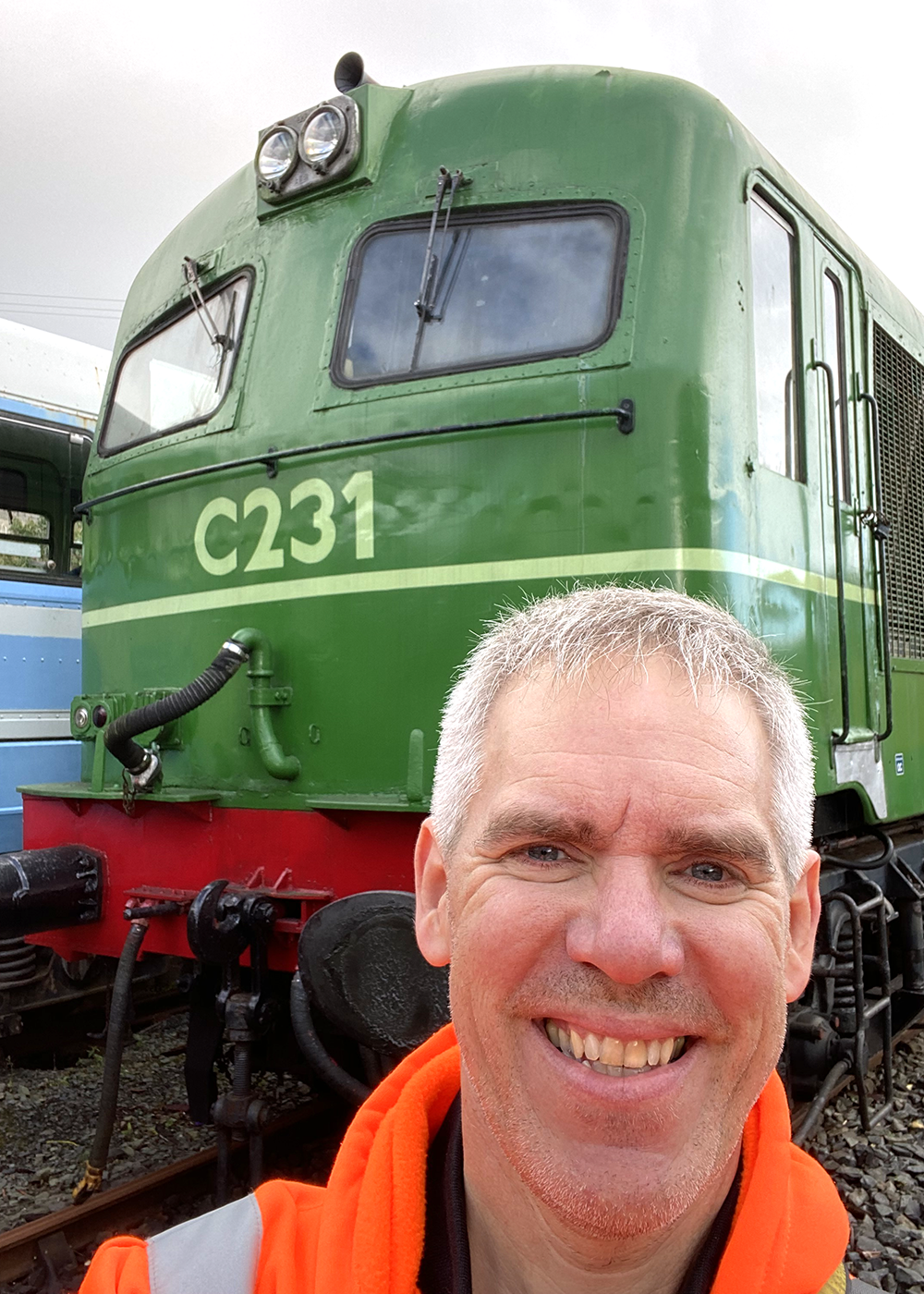
As part of our deep diving on the missing link in Irish model diesel locomotives, our C class Project Manager Gareth Bayer has studied the history of these locomotives extensively over the past couple of years.
Here he outlines the history of the claas, including their reliability woes, experiments and ultimate rebuilding with EMD power plants.
Take it away, Gareth!
CIÉ C Class History
Delivered between 1957 and 1958, the 34 members of Córas Iompair Éireann’s C Class, numbered C201–C234, were designed for branch-line operation, secondary services and station pilot duties. At just 42ft in length and weighing 58 tons, they were the diminutive Bo-Bo counterparts to the 60 larger, six-axle A Class locomotives built by the same British consortium between 1955 and 1956 for main-line passenger and freight work.
Both types had been specified by Chief Mechanical Engineer O.V.S. Bulleid, whose original recommendation to look across the Atlantic for new motive power was overruled. The family resemblance between the two classes was unmistakable. Developing just 550hp, the C Class locomotives were constructed by Metropolitan-Vickers, which supplied the electrical equipment and assembled the locomotives at its Dukinfield Works in Manchester. Nearby Crossley Brothers provided the two-stroke EST V8 engine, while Metropolitan-Cammell of Birmingham built the bodyshells and English Steel Castings was responsible for the one-piece Pennsylvania swing-bolster bogies.

The similarities extended beyond their external appearance, with both classes using the same MV137CW traction motors and many other common components, although the C Class was not initially equipped with staff snatchers. Fuel capacity was also limited to 300 gallons. The cab interiors were almost identical and established a template for subsequent Irish diesel types, being designed exclusively for single-person operation with dual controls. Neither class was equipped with train-heating equipment, helping to keep the axle load to 15 tons and ensuring system-wide route availability.
Within weeks of C201’s arrival in February 1957, the class had begun replacing steam on branch-line services, with the Farranfore–Valentia Harbour route the first to succumb to the new ‘baby’ Metrovicks. Cork and Dublin received allocations soon afterwards for pilot and goods duties, while steam was quickly displaced at Bray, Clonakilty and Skibbereen, on the Galway–Tuam route and on the freight-only Castlecomer branch. In October 1957, C204 began working cement trains on the new, three-mile Castlemungret branch. By the time the final locomotive was delivered in June 1958, C Class allocations had spread to Athlone, Limerick, Kilkenny, Mallow, Sligo and Waterford.
For branch-line duties, ten locomotives were fitted with a jumper box on the bufferbeam to supply power for electric train lighting. Sadly, over the following five years, many of these local routes closed, along with numerous other lines across the country. The C Class often found itself working the final trains on routes destined for closure. This widespread loss of work left the ‘baby’ Metrovicks increasingly surplus to requirements, and they were frequently transferred to duties for which they were ill-suited.

As well as sharing a family resemblance, the A and C Classes also shared many of the same shortcomings, reflecting the drawbacks of CIÉ’s rapid transition to diesel traction. The programme would see Ireland become the first European country to eliminate steam traction in 1963. As with the 1,200hp Crossley HST V12 engine used in the A Class and British Railways’ Co-Bos (Class 28), the EST engine in the C Class proved to be the fleet’s Achilles’ heel. Its unbalanced design caused vibration-related failures and fractures, particularly in pipework.
These problems emerged early and were compounded by cracked cylinder blocks, connecting-rod big-end failures, defective pistons and cylinder heads, exhaust fires, braking problems, high-water-temperature shutdowns, water ingress into the Hoffman axleboxes, and generator and traction-motor flashovers.
Despite numerous attempts to rectify these issues, it was clear by 1960 that new motive power was required, and CIÉ finally turned to General Motors. During 1962–63, more than 50 B121 and B141 Class locomotives arrived from LaGrange, Illinois, proving an immediate success. Their introduction eased the pressure on the railway’s most important passenger services, but there remained a need for the ailing Metrovicks to handle special passenger trains, freight, pilot and transfer duties.
When CIÉ made further approaches to GM for replacement engines, its requests were rebuffed. The railway therefore turned to Maybach in 1964 for a pair of 12-cylinder MD650 engines to evaluate in a trial. With only around a third of the C Class fleet normally available for traffic—an even worse record than the A Class—and the type being woefully underpowered, there was no shortage of potential donor locomotives.

C233 and C234 emerged from Inchicore following their rebuilds between August 1965 and May 1966, the pair being redesignated B233 and B234 to reflect their new 980hp rating. The rebuilding programme included enlarging the radiator grilles from six to ten elements and fitting a correspondingly larger roof fan. Bufferbeam-mounted vacuum pipes were also installed to allow the locomotives to work with AEC/Park Royal railcars.
The rebuilt locomotives acquitted themselves well, although they were initially restricted to services between Dublin and Limerick. The repowering experiment demonstrated that the type could have a future with CIÉ, but the complicated Maybach engine was not the answer.
The order for 12 B181 Class locomotives, equipped with the new EMD B-645E power unit, in 1966 appeared to be the catalyst that finally persuaded the Americans to release a pair of engines for evaluation in two A Class locomotives, A58 and A59, which were completed in 1968. The 12-cylinder EMD 645 engine proved a good match for the rewound Metropolitan-Vickers electrical equipment, and the remaining 58 examples of the A Class were subsequently rebuilt, with the programme completed by 1971.
In September 1969, former C206 emerged from Inchicore as B206, fitted with an eight-cylinder, 1,100hp version of the same EMD engine. B222 followed in 1970. The pair quickly settled into services between Dublin and Tralee, later also working Cork services. While the A Class repowering programme was winding down in 1971, Inchicore managed to complete approximately one C Class conversion per month, beginning with B230 in February 1971. The final locomotive, B220, was completed in mid-1972.

Like the Maybach-powered locomotives, which were not initially included in the GM repowering programme, the B201 Class was also fitted with multiple-unit sockets and bufferbeam-mounted control pipes to enable operation with similarly equipped B141 and B181 Class locomotives. However, only the Maybach-powered pair ever used this equipment.
Other improvements included dual headlamps of an identical design to those fitted to the A Class, staff snatchers to permit use on mail services, and an additional underframe fuel tank that increased capacity to 540 gallons.
The upgraded B201s found a new role on Dublin’s intensive suburban services, working alongside de-engined 2600 Class railcars from 1972. This partnership lasted until the creation of the electrified DART network in the mid-1980s. The locomotives also remained a familiar sight as station pilots across the network, while becoming regular performers on freight services, including the B+I liner train, cement and sugar-beet traffic, and permanent-way duties.
The first casualty was B201, lost in August 1973. Although it had received its GM engine as recently as June 1971, it was bombed at Meigh while working a Dundalk–Derry freight train. It was the only member of the class not to survive the decade.
The two Maybach-powered locomotives eventually received their GM rebuilds in 1979–80. Both retained their distinctive plated bodyside windows following conversion. The first withdrawals took place in April 1984, when 203, 204 and 207 were removed from traffic. No. 202 followed before the end of the year.
Four more locomotives—210, 214, 217 and 231—were retired in September 1985 as the new 8100 Class DART electric multiple units entered service in increasing numbers. At the end of that year, the first of a planned six locomotives moved to Northern Ireland Railways (NIR), initially on lease, for freight and departmental work. Regular passenger duties were largely impractical because of their vacuum-brake-only status.

Locomotives 216, 218, 227, 228 and 230, together with ex-Maybach 234, were renumbered 104–109 and became known as the MV or 104 Class. NIR purchased them outright in April 1986.
A major cull of the class followed in September 1986, leaving only 213, 218 and 232 in traffic. The class officially ended its CIÉ service in November 1986, although 213 continued working as a pilot at Inchicore until February 1988. No. 218 joined its counterparts at NIR in 1987, following the discovery of a bent frame on 224.
In 1990, desperate for long-distance rolling stock, Iarnród Éireann struck a deal with Leicester-based Vic Berry to exchange withdrawn C201 Class locomotives for British Rail Mk.2 coaches that had been sold for scrap. Fourteen locomotives were eventually cut up in the UK. These included several examples from Inchicore’s notorious ‘sound barrier’: a long line of redundant ‘baby’ Metrovicks intended to keep residential neighbours happy by providing a barrier against railway noise.
Of the remaining locomotives, all but 226 and 231 were scrapped at Inchicore. No. 226 is now based at Carrick-on-Suir, while 231 can be found at the Downpatrick & County Down Railway in Northern Ireland. Both are preserved by the Irish Traction Group.

Unfortunately for NIR, the anticipated freight contracts that had prompted the purchase of the 104 Class never materialised. No. 107 is believed never to have worked for the operator. Stored in its new NIR livery at Belfast York Road, it became the first to be withdrawn, in March 1993. It was scrapped alongside 224 at Ballymena in January 1996.
No. 109 was out of use by August 1987 and was cut up at York Road in March 1993. Of the other four locomotives, 105 was withdrawn from traffic in November 1993 following a fire, while 104 and 108 were stopped at the end of 1994. MV106, formerly 227, was the last to remain in service, surviving until March 1995. It was subsequently preserved, initially at Cahirciveen, County Kerry, but exposure to the elements and later vandalism took their toll. The locomotive has since been scrapped. The other three members of the group met the gas axe at Harland & Wolff, Belfast, in August 1997.
Like the A Class, their smaller counterparts wore a colourful array of liveries throughout their working lives. Both classes were initially delivered in a striking all-over silver scheme that extended to the running gear, where every Crossley-related oil stain was on full display.
From early 1958, the silver began to give way to green with a thin Eau de Nil band, although by 1960 this had been simplified to all-over green. In 1962, the first examples were repainted in an attractive new scheme of black with a golden-brown lower bodyside and a white upper-body stripe, known colloquially as ‘black and tan’.

Later in the decade, this was simplified to a more austere all-black scheme, relieved only by the ever-present red bufferbeams—a feature of CIÉ liveries—and a white band above the cab windows. Some locomotives later received half-yellow cab fronts, while at least one had a yellow bufferbeam.
‘Black and tan’ returned to the class in 1969, when prototype B206 emerged from its rebuild in the original 1962 scheme. This was subsequently modified to incorporate a dipped centre section on later repaints, with the exception of the Maybach-powered pair.
In 1973, the Supertrain livery of golden brown and black made its debut on the class. The locomotives would wear this scheme until the end of their CIÉ careers. The six locomotives sold to NIR, meanwhile, received that operator’s all-over blue livery, complete with orange chevrons on the cab fronts.


