

Someone once asked, "War, what is it good for?"
The answer came back: "Absolutely nothing!"
And while our Longmoor Military Railway train pack owes its existence to war, it's certainly something beautiful to behold. So, on this occasion at least, we may have to disagree with Mr Edwin Starr and his 1970s classic.
Following our recent update on the main range of Hunslet Austerity locomotives, we're delighted to confirm that our Longmoor Military Railway train packs will also arrive in stock this September.

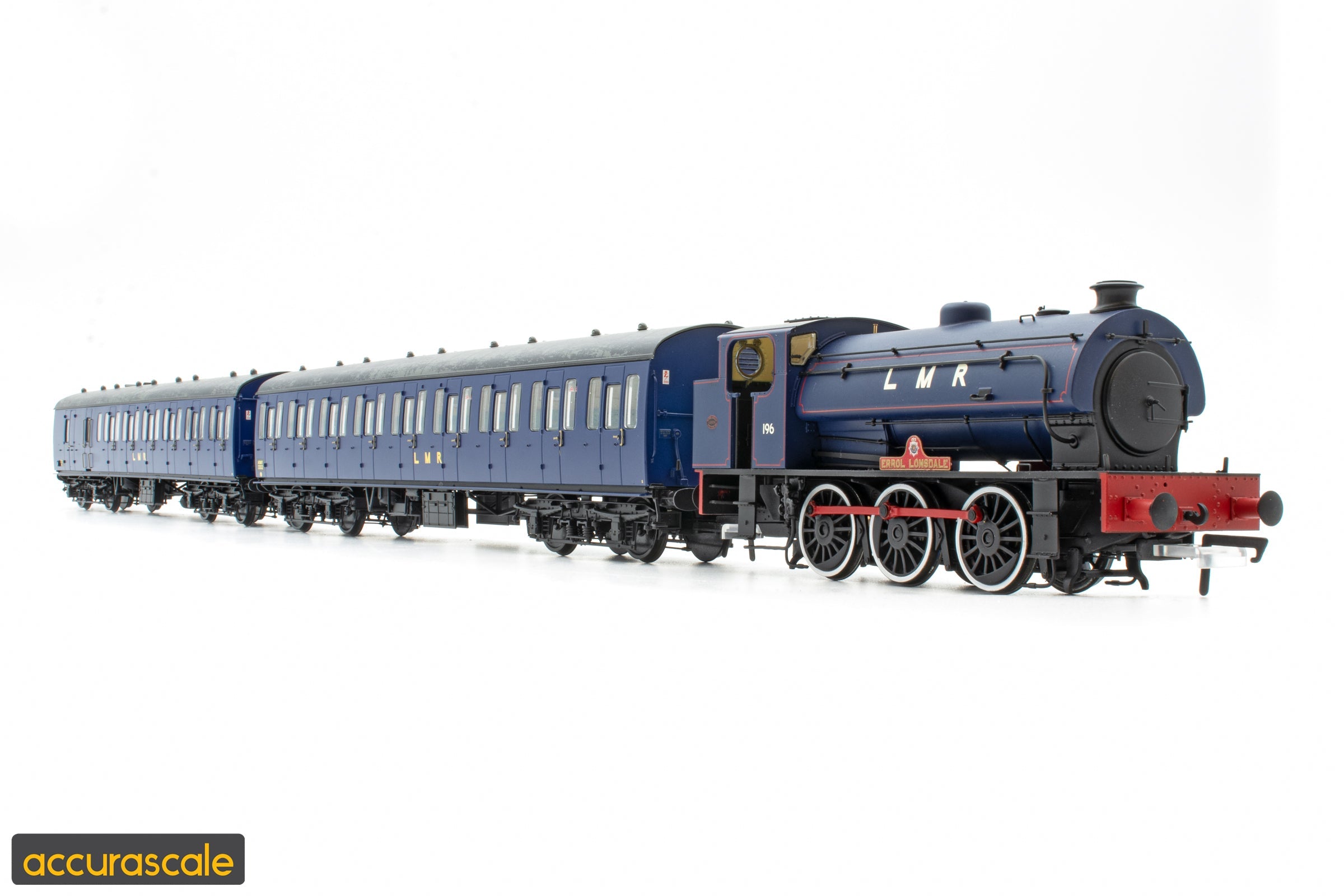
Featuring one of our exquisite 57ft Mk.1 suburban coach pairs alongside Hunslet Austerity Saddle Tank No. 196 Errol Lonsdale in the striking Longmoor Military Railway blue livery, our first train pack captures the LMR during its most memorable era for railway enthusiasts.
History of the LMR
Beginning life as the Woolmer Instructional Railway in 1909, the British Army operated the Longmoor Military Railway for over sixty years as a complete strategic railway training system. Entirely self-contained, the LMR became increasingly popular with railway enthusiasts, with its famous Open Days and special trains during the 1960s influencing both its locomotive fleet and passenger rolling stock.
As post-war training commitments reduced, worn-out stock was replaced rather than repaired. British Railways rolling stock was acquired by 1 Railway Group Royal Engineers, including surplus Mk.1 non-gangway compartment coaches purchased during the mid-1960s to cope with growing passenger numbers at Open Days and special events. Many were repainted into the attractive LMR Oxford Blue livery to maintain a smart and uniform appearance.
The Locomotive

Hunslet Works No. 3796 was completed in 1953 to the wartime Austerity design. Deemed surplus almost immediately, it spent time in storage before entering traffic in 1955, working at Honeybourne, Bicester and Longmoor throughout its career.
Its first starring role came in 1965 when Longmoor was used to film The Great St Trinian's Train Robbery. Renumbered 68011 and painted black to represent a BR J94, it returned to Longmoor blue following filming, although traces of 68011 remained visible on its smokebox door!
Its second film appearance came in 1967 during the filming of Chitty Chitty Bang Bang. Remaining in blue, the locomotive received temporary GWR tank lettering to conceal its LMR markings, a brass-painted dome cover and an impressively tall chimney extension.

An interesting connection exists between Chitty Chitty Bang Bang and the railway world. Count Louis Zborowski, whose famous racing car inspired the story, was a passionate railway enthusiast and partnered with Captain J. E. P. Howey in establishing the Romney, Hythe and Dymchurch Railway, although sadly he never saw it completed.
In January 1968, No. 196 was named Errol Lonsdale after Major General Errol Lonsdale, then Chief of Army Transport. It became the last locomotive to be named at Longmoor and received its distinctive white-painted wheels ahead of carrying its new nameplates.
Following Longmoor's closure in 1970, 196 entered preservation, spending time on the Kent & East Sussex Railway, Mid Hants Railway and South Devon Railway, where it once again appeared in its film-star guise as 68011. Since 2009 it has resided at the Stoomcentrum in Maldegem, Belgium, restored to working order and carrying its original WD green livery.
The Coaches

Historical records differ slightly regarding the total number of Mk.1 coaches transferred to Longmoor, with LMR records listing thirteen vehicles while other sources suggest eighteen were transferred between 1965 and 1968.
Upon arrival, all were finished in BR lined maroon, many still carrying their condemned markings. Several coaches retained their original liveries throughout their service lives, while others were repainted into either Olive Drab or the handsome LMR Oxford Blue livery during 1967 and 1968.
Our models represent Brake Second ARMY 5301 (ex-M43231) and Second ARMY 3302 (ex-M46070) as they appeared in 1968 wearing LMR Oxford Blue.

ARMY 5301 began life at Doncaster Works in 1954 before transferring to the LMR in February 1965. After carrying various AD prefixes, it became ARMY 5301 in 1968. Initially painted Olive Drab, it received LMR Oxford Blue in 1967 before entering preservation following Longmoor's closure. Sadly, it was scrapped in 1982.
ARMY 3302 was built at Derby Works in 1954 and transferred to Longmoor in early 1968, carrying its ARMY number from the outset. Repainted into LMR Oxford Blue upon arrival, it survived only briefly after preservation, being scrapped in 1971.
Delivery and Pre-Ordering

As you can see from the latest images, our Longmoor Military Railway train pack is now complete and on its way to us, with delivery expected in mid-September.
We have a limited quantity of this Accurascale Exclusive train pack remaining, priced at £299.95 in DC/DCC Ready form or £399.95 with factory-fitted DCC sound.
Each set comes presented in special limited-edition packaging and includes an individually numbered certificate.
Don't miss your chance to own this unique and evocative slice of British railway history.


